Most AI in healthcare fails quietly. It performs well in demos, holds up in controlled pilots, and then collapses under the weight of real patients, real data systems, and the complexity of live clinical workflows. The gap between what AI can do in a test environment and what it can sustain in production is where most vendors disappear.
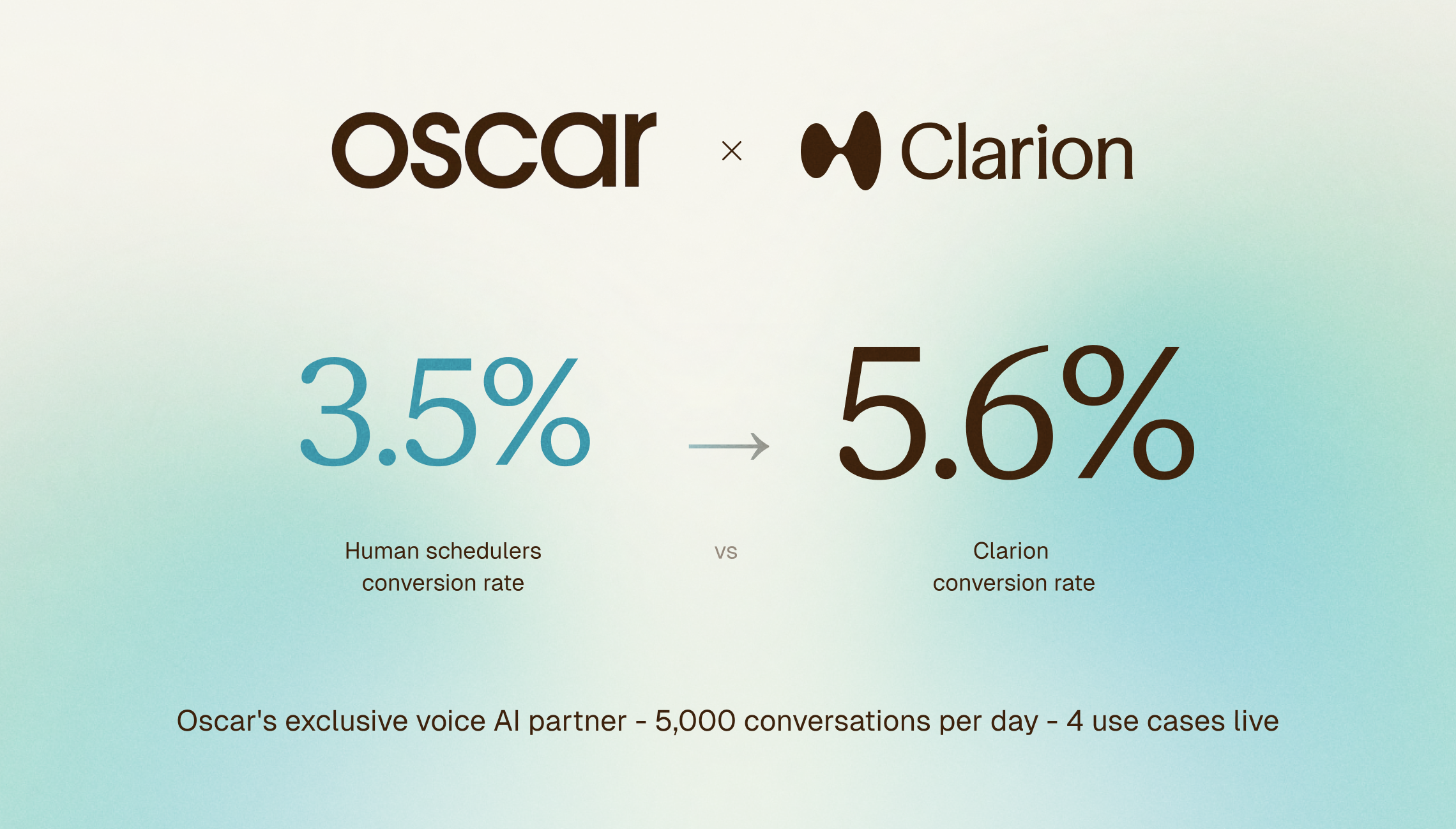
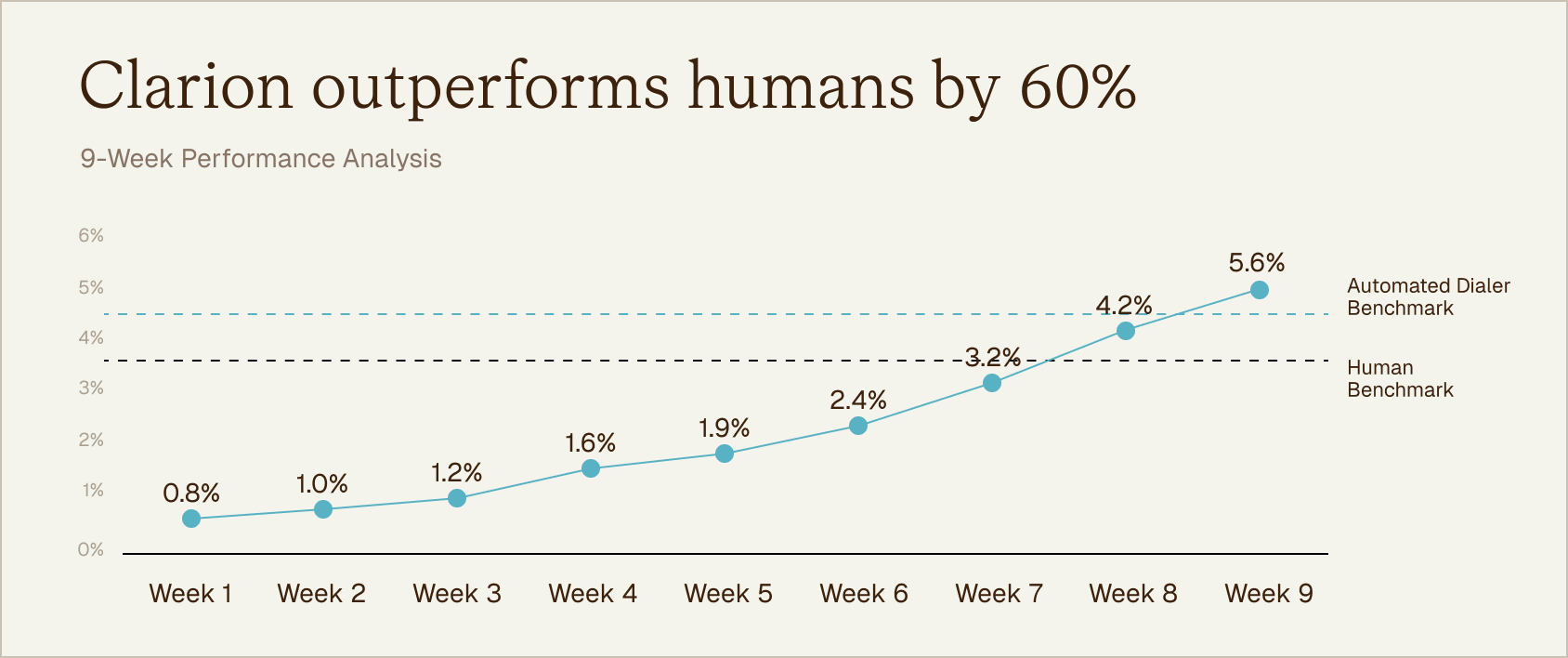
In September 2024, Oscar Health chose a different path. They partnered with Clarion to automate outbound scheduling calls for their Virtual Health Assessment program. The first week, the AI converted less than 1% of calls. Oscar's human team was at 3.5%. The gap was real, and expected. What happened next is the point. Through 100+ iterations of rigorous conversation engineering and a phased deployment process built for a clinical setting, Clarion's agent reached 5.62% conversion, 40% above the human benchmark. Today it handles over 40,000 calls per month across four active use cases. Getting AI to work in healthcare is not a launch. It's a practice.
A Partnership Built on Rigor
Oscar Health is a Fortune 500 health insurance company serving nearly three million patients. They run proprietary AI models for claims processing and risk adjustment. When they evaluate an AI vendor, they know the difference between a compelling demo and a system that performs in production.
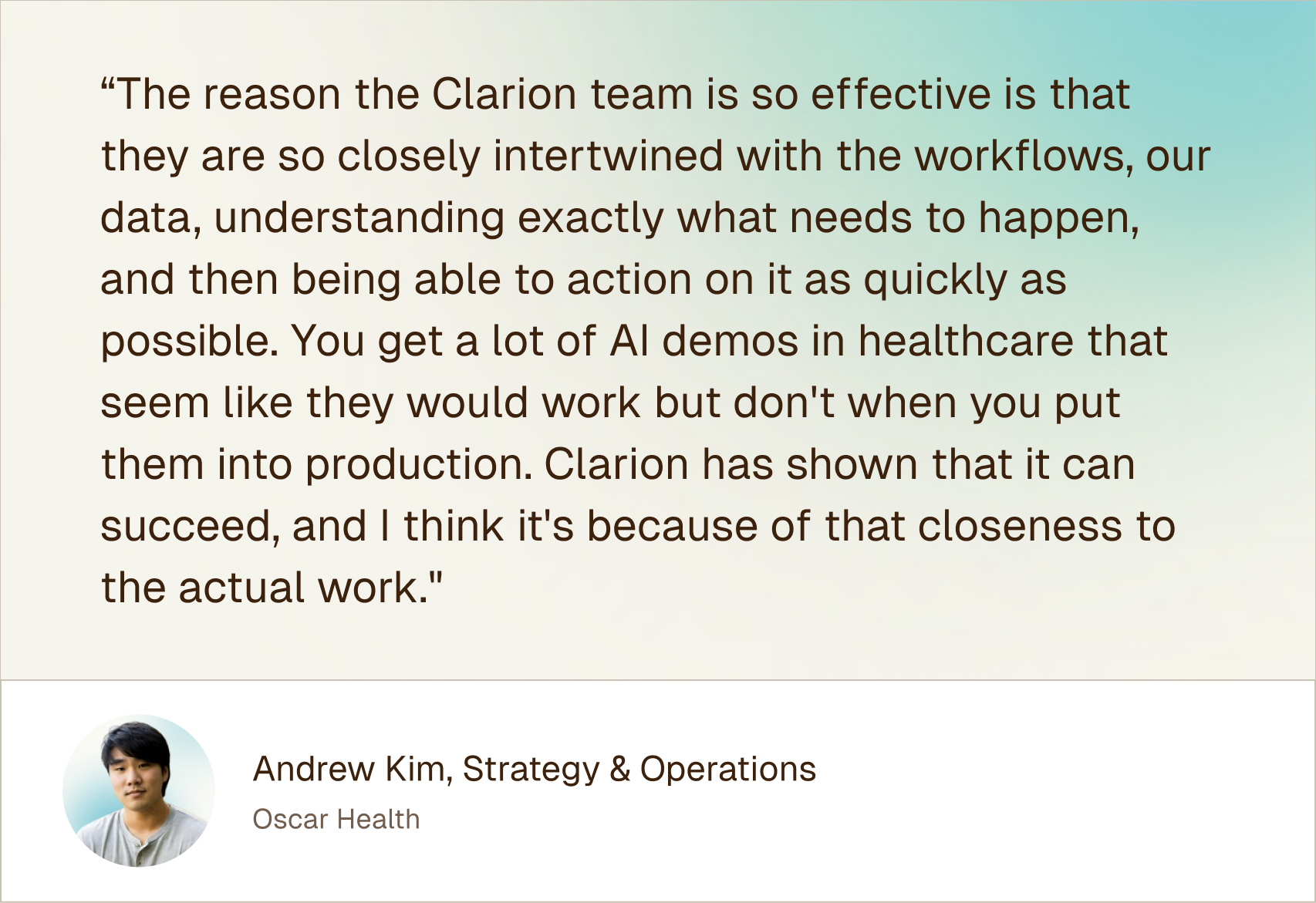
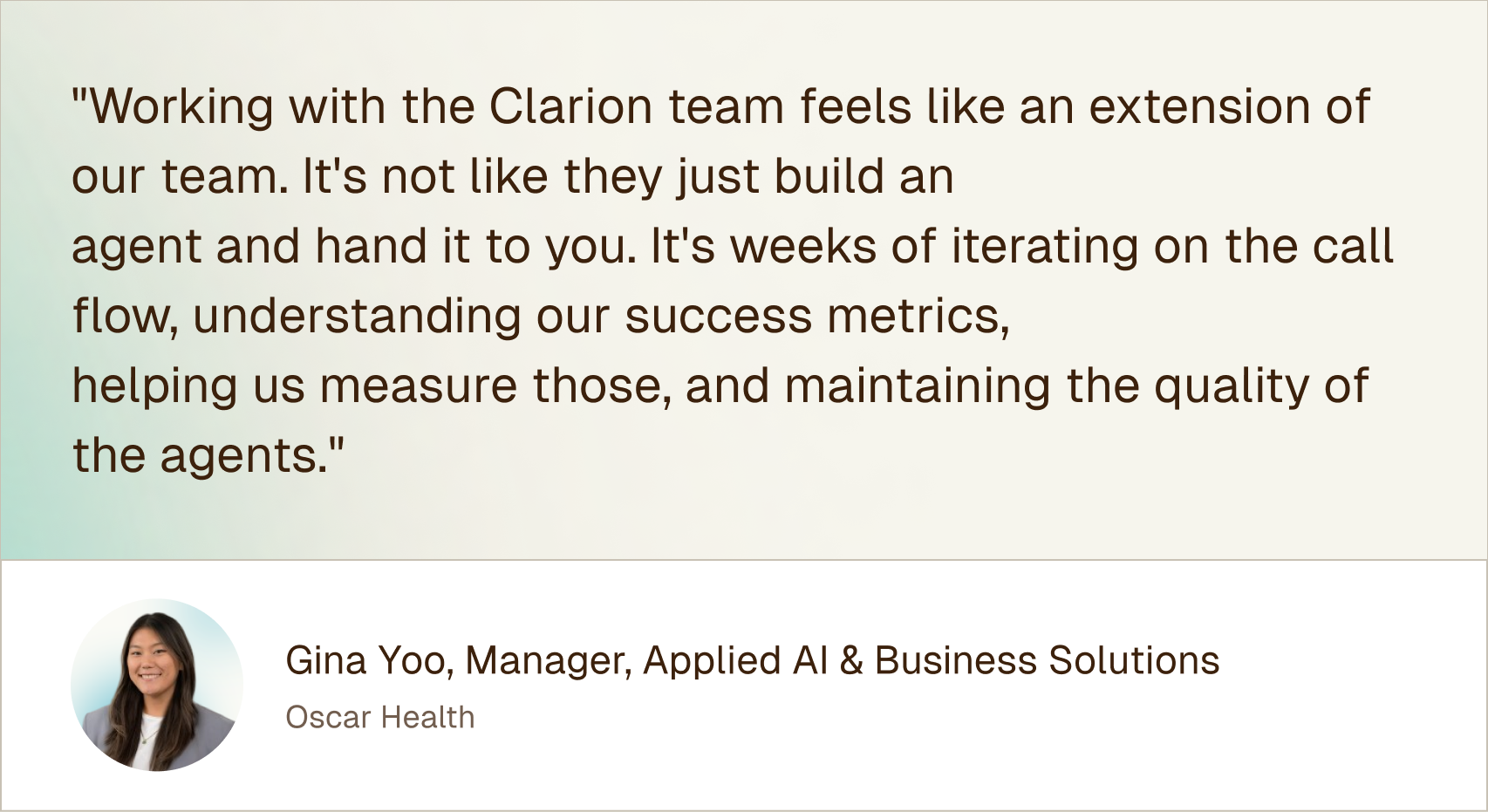
Their evaluation included a formal RFI, a security review, and a live bake-off on real call quality. Two factors separated Clarion from the field: the quality of the patient experience (natural conversational patterns, clear audio, and interactions that felt like real conversations rather than automated notifications) and the model for how the partnership would work. Rather than handing over tools and stepping back, Clarion embeds in the customer’s workflows, owns performance outcomes, and iterates alongside the team long after deployment.
The Problem
Oscar’s Virtual Health Assessment (VHA) program is both a clinical priority and a meaningful revenue driver. Completed VHAs surface undetected health conditions and generate risk adjustment revenue. The challenge was structural.
Oscar’s outreach list ran into the hundreds of thousands, a volume that strained any fixed-headcount call center team. Outreach was constrained to business hours Monday through Friday, 7 AM to 7 PM, leaving any patient unavailable during that window effectively unreachable. Even patients who answered were hard to convert. Motivating someone to schedule a preventive health appointment requires personalization and persistence that standardized call scripts rarely deliver.
Safety and Governance
Before a single patient received a call, Oscar conducted a multi-stage evaluation designed to surface every meaningful failure mode. The process moved from a formal RFI and security review to internal testing with Oscar employees acting as patients, then to an AI governance board that developed a proprietary framework defining what safe, accurate, and appropriate performance looked like for Oscar’s specific population.
The most distinctive step was synthetic testing. Clarion built AI voice bots to simulate patient interactions at scale, running thousands of automated conversations against the governance framework before any real patient was contacted. Edge cases that are rare in live traffic but critical to handle correctly were stress-tested in a controlled environment. Only after synthetic testing cleared did live calls begin, starting with a sampled subset of traffic and scaling gradually as each performance gate was met.
The confidence to scale came from the work done before scaling began.
A voice conversation is not a script. It’s a system with variables, feedback loops, and measurable outputs at every stage. Clarion treated it that way. Every change was hypothesized, tested, measured, and built upon.
The pilot launched at less than 1% conversion. Across more than 100 variations, each governed by a rigorous change management framework, the team worked across the full length of the call: trust-building in the opening seconds, dynamic voice and demographic targeting, incentive structures, objection handling, intelligent appointment slot prediction, and HIPAA-compliant verification woven into the flow without degrading the patient experience.
This isn’t a story about a single breakthrough. It’s a story about a method, where each marginal improvement creates the conditions for the next.
Results
By December 2025, Clarion’s agent reached a 5.62% conversion rate, compared with a 3.5% human benchmark and a 4.3% automated dialer benchmark. What began at 75 calls per day scaled to 20,000 VHA calls per month, with a peak of 13,000 calls handled in a single day.
The partnership has since expanded to four active use cases: VHA scheduling, VHA appointment reminders, Medicare coordination of benefits with a 99%+ call completion rate and roughly 15,000 calls per month, and provider scheduling, now in Phase 1 testing. Alongside scheduling, Clarion deployed reminder calls to manage confirmations, reschedules, and cancellations ahead of VHA appointments, reducing no-show rates by X%.
Clarion now generates more than 40,000 patient conversations per month across 375,000 eligible patients.
Built to Scale
The challenges Oscar faces aren’t unique to health plans. High call volume, limited staffing, complex scheduling logic, and the need to reach patients across different demographics and availability windows are everyday realities for specialty groups and health systems running care coordination at scale.
Vendors that struggle in this environment tend to show up with a rigid product and a retraining plan. But no two healthcare practices are the same. Each has its own scheduling logic, its own EHR, and its own patient population. A template that works in one setting rarely holds up in another.
The methodology developed with Oscar, grounded in rigorous governance, synthetic testing, phased deployment, and continuous conversation engineering, is designed to adapt. The process stays consistent. The agent is always tailored to the partner.